How to Build Conversion Data Everyone Can Reproduce
Build reliable conversion data with clear event contracts, stable IDs, observable deduplication, and end-to-end validation.
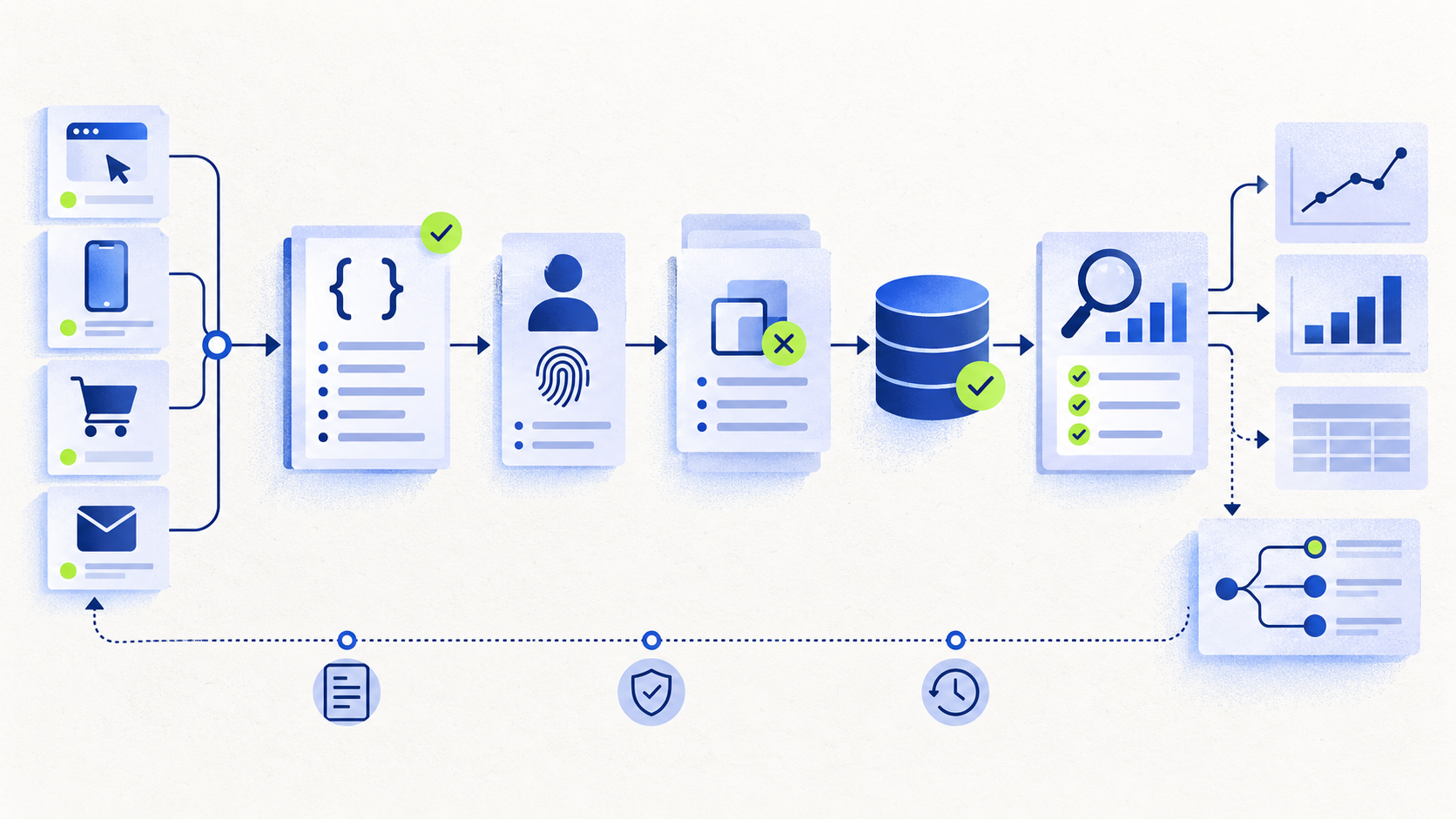
Conversion data is often trusted until it is compared.
Marketing sees one number in an ad platform. Product sees another number in an analytics report. Finance has an order total in a back-office system. Each number may be reasonable on its own, but the differences create uncertainty about which one should guide a decision.
The usual response is to create a reconciliation spreadsheet. That may help explain the past, but it does not improve the system that produced the disagreement.
The better approach is to design conversion data so that every important event can be traced and reproduced from the start.
Define the business moment
The first question is not technical: what exactly counts as a conversion?
A purchase can mean payment authorisation, successful payment capture, order creation, fulfilment, or a completed return window. A signup can mean form submission, email verification, account activation, or first meaningful product action.
None of these definitions is universally correct. The problem appears when different systems use different definitions while sharing the same event name.
Start with a plain-language statement: “This event is created when…” Then document the business owner who can approve changes to that meaning. That one sentence prevents a surprising amount of confusion later.
Give every event a stable identity
Once the business moment is clear, the event needs an identifier that survives retries and multiple delivery paths.
Why? Because the same conversion can legitimately be sent more than once. A network request can time out after the receiver accepted it. A server may retry a delivery. A browser and a server may both represent the same action. A destination may process events asynchronously.
Without a stable event ID, the system cannot distinguish “a legitimate retry of the same conversion” from “a second conversion that should be counted.”
The event ID should be created as close to the business moment as possible and travel with the event through collection, transformation, reporting, and activation. It becomes the thread that connects every view of the conversion.
Treat the payload as a contract
An event contract should describe more than the event name. At a minimum, it should specify:
- The business moment represented.
- A stable event ID.
- Event time and time-zone expectations.
- Required properties and allowed formats.
- Currency and value rules where relevant.
- Consent or purpose context.
- Retry behaviour.
- Destination-specific transformations.
- The owner responsible for changes.
This does not make implementation slower. It prevents expensive interpretation work after the event is already in production. It also makes onboarding easier: a new teammate can understand what a conversion means without reverse-engineering code or asking several people.
Make deduplication observable
Deduplication should not be a hidden rule that customers discover only when a total looks low. A trustworthy system can explain the outcome.
For a selected period, a team should be able to see how many events were received, how many were accepted, how many were identified as duplicates, and why. That does not mean exposing every internal detail in the default interface. It means providing a clear investigation path when a customer needs to understand a result.
The goal is not to suppress as many events as possible. The goal is to count the right business event once.
Validate the full path
Before a conversion event is considered complete, trace one known example through the system:
- Confirm the event was collected with the expected ID and properties.
- Confirm transformations did not change the business meaning unexpectedly.
- Confirm the reporting layer uses the intended aggregation and deduplication rule.
- Confirm the destination received the event in the expected form.
- Confirm any discrepancy is documented rather than silently ignored.
This exercise turns a vague integration claim into evidence. It also creates a reusable acceptance test for future changes.
Reproducibility is the real standard
Perfect agreement between every system is not always possible. Different platforms use different attribution windows, processing times, and reporting rules. But teams should be able to explain those differences from a common, traceable event record.
That is the standard worth aiming for: not a single number that never changes, but a conversion that every team can define, follow, and reproduce.
Make every high-value conversion traceable before making it attributable.