AI visibility is easy to oversimplify.
Someone asks, “Are AI systems visiting our site?” A dashboard produces a large number. The team sees a familiar bot name, a few active pages, and perhaps an appealing trend line. It is tempting to treat the answer as complete.
But an AI visibility audit is only useful when the team can explain what the number contains, what it excludes, and what it plans to do next. Otherwise, the report becomes another dashboard that creates confidence until the first detailed question arrives.
The good news is that a trustworthy audit does not need to be complicated. It needs a clear scope, honest classification, page-level context, and a short list of actions that the data can actually support.
Start with the decision, not the dashboard
Before opening a report, write down the decision you need to make. The answer will determine the data you need.
For example:
- Do we want to know whether priority content is being requested by recognised AI agents?
- Do we want to identify a sudden increase in automated requests to a sensitive page?
- Do we want to understand which pages deserve a technical accessibility review?
- Do we want to compare AI-referred human visits with observed machine activity?
Each question requires a different view of the data. A generic “AI traffic” total may be a useful starting point, but it cannot answer all of them.
Declare the scope before reading the result
Every audit should begin with a short scope statement. It should include:
- The site, tenant, or domain being reviewed.
- The selected date range and time zone.
- Any source, environment, page-path, or search filter.
- The agent categories included in the result.
- The method used to recognise or verify agents.
- Any aggregation, top-N, sampling, or retention limitation.
This may sound procedural, but it prevents most reporting arguments. When a stakeholder asks why two screens show different totals, the first response should be to compare their scope—not to debate which number feels more believable.
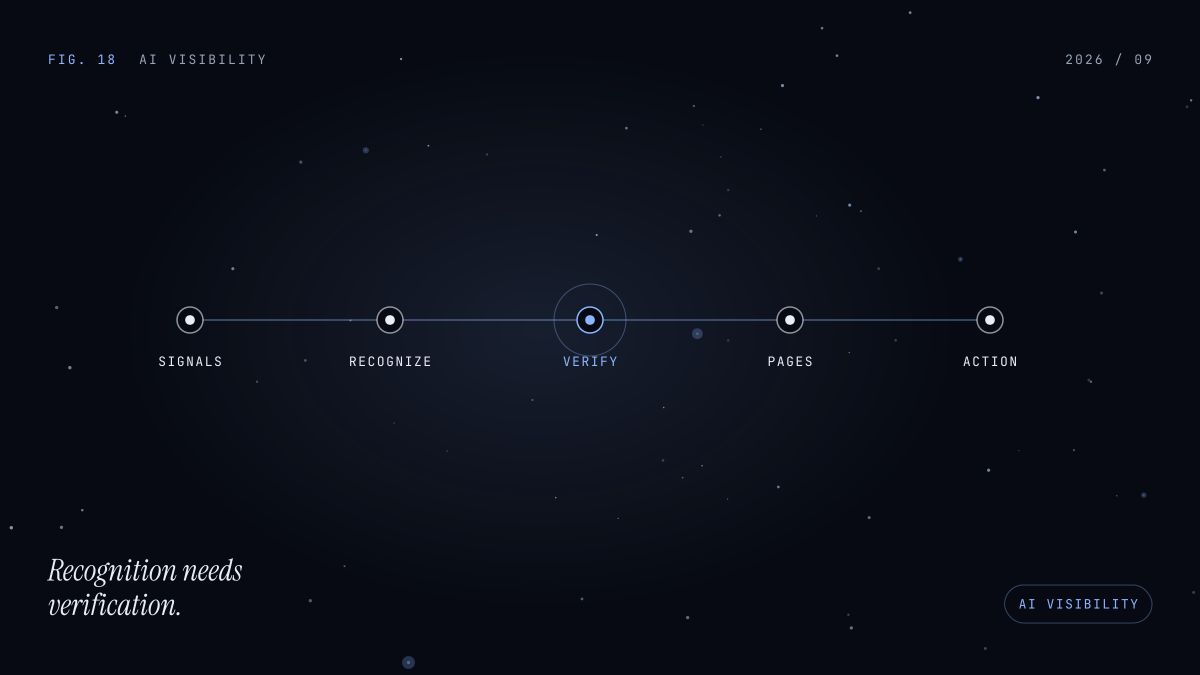
Separate recognition from verification
Classification is useful. It helps a team group requests by agent, platform, or category. But classification should not hide uncertainty.
A helpful report can distinguish between a request that matches a known agent signature and a request whose identity has been verified according to the available method. It can also leave room for unknown or ambiguous traffic instead of forcing every request into a confident category.
This approach is more valuable than a single total because it gives the team a way to act responsibly. Verified activity may be suitable for trend analysis. Recognised but unverified activity may be useful for monitoring. Unknown activity may prompt a security or infrastructure investigation. These are different follow-up paths.
Join agents to pages
The most useful AI visibility question is rarely “Which bot visited?” on its own. It is usually “Which agent requested which page, how often, and why does that page matter?”
That is why an audit should connect the Agents view to the Pages view. Start with a list of priority pages: product pages, pricing pages, high-intent landing pages, key documentation, and important editorial content. Then compare observed activity across those pages.
Look for patterns, not conclusions:
- A priority page with no observed activity may deserve an accessibility or discoverability review.
- A page with unusually high activity may deserve a technical review or content-quality check.
- A new agent reaching a sensitive page may require monitoring.
- A page frequently requested by agents but rarely visited by referred humans may prompt a content or conversion hypothesis.
None of these observations proves an outcome. Each one gives the team a better next question.
Make the report reconcile
Trust also depends on arithmetic. If a page total says 1,000 requests, the expanded agent breakdown should add up to 1,000 for the same filters. If a top agent is named, it should be derived from the same dataset as the total. If a detail table uses only recent events, the product should say so rather than presenting it as a complete historical breakdown.
This is not only an engineering concern. It is customer experience. A report that reconciles gives marketing, support, and product teams a shared language. A report that does not reconcile forces each team to invent its own explanation.
End with a next-action list
An audit should finish with a few owned actions, not a slide full of observations. Use a simple format:
| Observation | Confidence | Owner | Next action |
|---|---|---|---|
| Priority page has no observed activity | Medium | Content + Engineering | Check accessibility, links, and page freshness |
| Sudden rise in recognised but unverified requests | Medium | Engineering | Review request patterns and verification method |
| Strong agent activity on a product page, weak referred visits | Low-to-medium | Marketing | Review page clarity and related AI referral data |
The point of AI visibility is not to predict every AI outcome. It is to replace guesses with a repeatable observation-and-investigation process.
Sources: Hardal AI Visibility documentation · Hardal AI Visibility Playbook