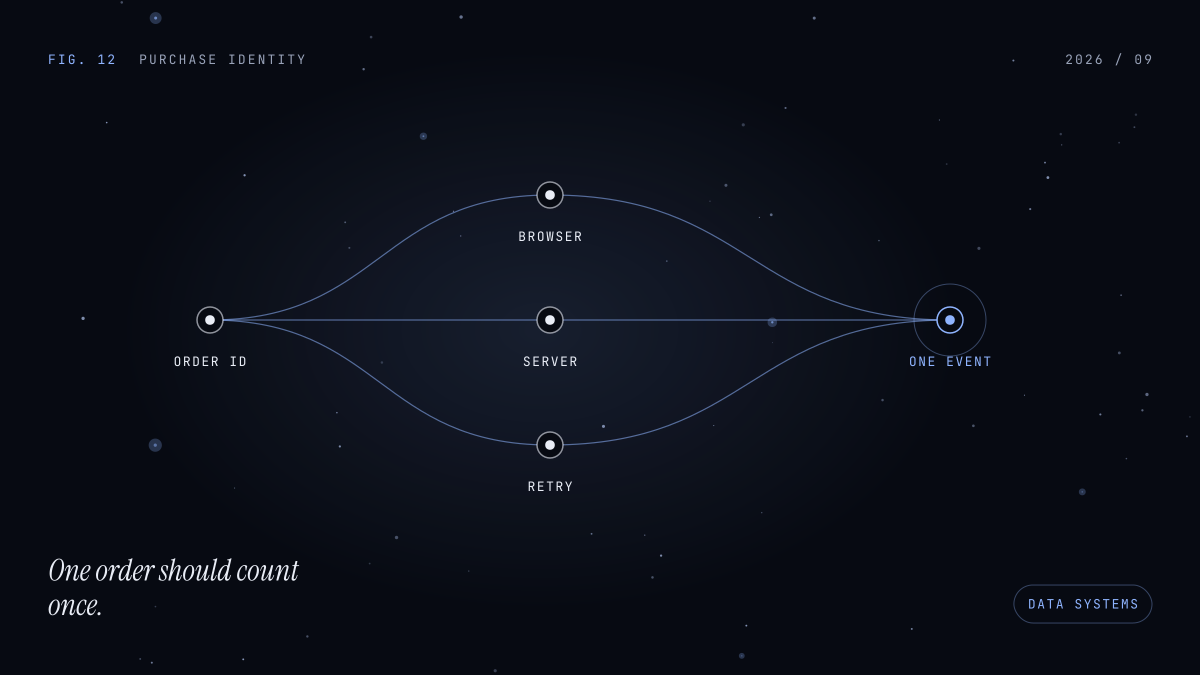
A purchase is one business outcome, even when several technical events describe it.
The confirmation page can reload. A browser tag and a backend worker can both send a purchase. A queue can redeliver a message after a timeout. Each request may be valid on its own, but counting every delivery as revenue changes the answer to a basic question: how many orders did the business receive?
Purchase event deduplication keeps delivery behavior from becoming business truth. It starts with defining the identity of an order, separating that identity from request attempts, and testing the paths that can produce duplicates.
Why duplicate purchases are a systems problem
Duplicate purchase events rarely happen because someone deliberately tracks the same order twice. They emerge at boundaries between systems with different reliability guarantees.
A customer can refresh a confirmation page and run the page code again. A server can accept an event while the sender times out before receiving the response. A queue consumer can receive a message more than once. A mobile app can reconnect after its backend has already confirmed the purchase. These are ordinary distributed-systems failure modes, so an analytics pipeline needs to account for them.
The key distinction is between a delivery log and a business aggregate. A delivery log may retain every request for debugging. A revenue report or campaign model should normally count each confirmed order once. If both use the same raw rows without an explicit deduplication rule, retries can quietly inflate revenue.
Platforms may apply their own rules. For example, Google Analytics documents that when the same ecommerce event is sent twice with the same transaction ID, it collects the first and ignores the second, even if values in the later event differ. That behavior is useful, but it should not be your only protection: downstream systems can use different rules, and a malformed first payload can make a later correction difficult.
Separate order identity from delivery identity
Start with identifiers that answer different questions:
- Transaction ID: Which commercial order or conversion does this event represent?
- Idempotency key: Is this a retry of the same API operation?
- Delivery ID: Which individual send attempt should an operator trace?
The transaction ID is the business key. It should be stable for the life of the order, unique within a documented scope, and generated by the system that owns order creation. Avoid page-load timestamps, random browser values, or email addresses. If order numbers can repeat between stores or environments, include a non-sensitive namespace in the uniqueness rule.
An idempotency key protects an API operation from being performed twice when that operation is retried. Reuse the same key when retrying that operation, and follow the API provider’s rules for its lifetime and scope. A transaction ID identifies the order across a longer lifecycle and across event producers. Keep the two concepts separate.
A delivery ID has an operational purpose: it helps answer, “Why did this receiver see several requests?” It can identify a send attempt in logs, but it must not replace the stable transaction ID used to recognize the order. If your delivery system needs a stable message ID across redeliveries, record that separately from a per-attempt request ID.
A compact event contract could look like this:
{
  "event_name": "purchase",
  "transaction_id": "store-a:ORD-10428",
  "delivery_id": "b0f3c00d-1234-4a8b-a2ad-9a7f89c12e8b",
  "occurred_at": "2026-09-25T08:42:11Z",
  "order_status": "confirmed",
  "value": 214.98,
  "currency": "USD",
  "items": [
    { "item_id": "SKU-42", "item_name": "Trail Jacket", "price": 214.98, "quantity": 1 }
  ],
  "schema_version": 1
}
The fields are intentionally plain. A processor can use transaction_id to identify the canonical conversion, delivery_id to investigate a request, and schema_version to interpret the payload later. Keep item identifiers consistent across product-view, cart, and purchase events so journey analysis can join the same product without relying on display text.
For more on making conversion records traceable from source to report, see How to Build Conversion Data Everyone Can Reproduce.
Choose one owner for the confirmed purchase
Decide which system owns the authoritative purchase signal. In many commerce systems, that is the backend after the order reaches the state your business defines as confirmed. A backend signal does not depend on a visitor loading or keeping a confirmation page open.
Browser events can still be useful for immediate interface analysis, funnel context, or debugging. The important part is to give browser and server signals distinct roles. If both can emit a purchase, they need the same transaction ID and a documented canonicalization rule at the receiving or processing layer. When possible, select one owner for the final conversion and treat other signals as diagnostic or reconciliation data.
An outbox-style workflow can make the server path more reliable: persist the confirmed order and an event to deliver in the same business transaction, then let a worker send it and record the outcome. A retry should reuse the original transaction ID. The receiver or processing layer can enforce uniqueness for the canonical conversion while retaining delivery attempts for operations.
Status changes also need clear semantics. A cancellation, refund, or correction does not mean the original delivery should be resent with altered values. Define how adjustments are represented and reported. Otherwise, one destination may ignore the change as a duplicate while another counts it as new revenue.
Hardal’s Track a Purchase guide recommends sending a purchase when an order is confirmed, with a stable transaction_id and item details. Its Campaigns Report guide describes how transaction_id, value, and currency support conversion and revenue reporting. Those details make the source of truth and identity rule decisions teams can document together instead of assumptions scattered across tags.
Test the paths production will take
Deduplication is easy to claim and easy to break. Test it at the event boundary before a campaign or release depends on the numbers. Use one known test order and cover at least these cases:
- Reload the confirmation page and check whether a second raw delivery appears.
- Send browser and backend events with the same transaction ID.
- Simulate a timeout after the receiver accepts a request, then retry it with the correct idempotency behavior.
- Reprocess the same queued message.
- Attempt to reuse a transaction ID for a genuinely different order and confirm the system rejects or flags it.
Be precise about the expected result: raw delivery attempts may increase, but the canonical confirmed-order count and revenue should not. Also check the fields analysts need, including currency, value, items, source context, and confirmed status. Deduplication that preserves the wrong first payload is still a reporting problem.
For web implementations, inspect the collection request in the browser Network panel. Hardal’s Web Setup guide documents checking that the tracker loads from the configured first-party URL and that a collection request returns 202. For server-side events, perform an equivalent request-and-response check and audit transaction IDs in the receiving store. A dashboard helps confirm the result, but it does not replace observing the request path.
For a broader delivery checklist, see The Server-Side Delivery Checklist.
Make one order count once
Audit one purchase path this week. Write down the transaction-ID rule, identify every client and server emitter, replay a successful delivery, and compare raw attempts with canonical conversions. Then use Hardal’s Track a Purchase guide and Campaigns Report guide to check that your first-party purchase signal contains the fields needed for reliable revenue and attribution.